0
Wake-Initiated Lucid Dreaming (WILD)
Learn how to remain aware as the body falls asleep — and consciously enter lucid dreams directly from waking awareness.
This course offers a grounded, experience-based approach to Wake-Initiated Lucid Dreaming (WILD), Out of Body Experiences (OBE), hypnagogic states, deep meditation, and conscious state exploration.
Rather than relying on random lucid dreams, you’ll learn how to gradually develop continuity of awareness during the transition between waking and dreaming.
• 15+ years of teaching and practice
• 1,000+ documented lucid dreams
• 35,000+ students worldwide
30-day money-back guarantee
What Is Wake-Initiated Lucid Dreaming?
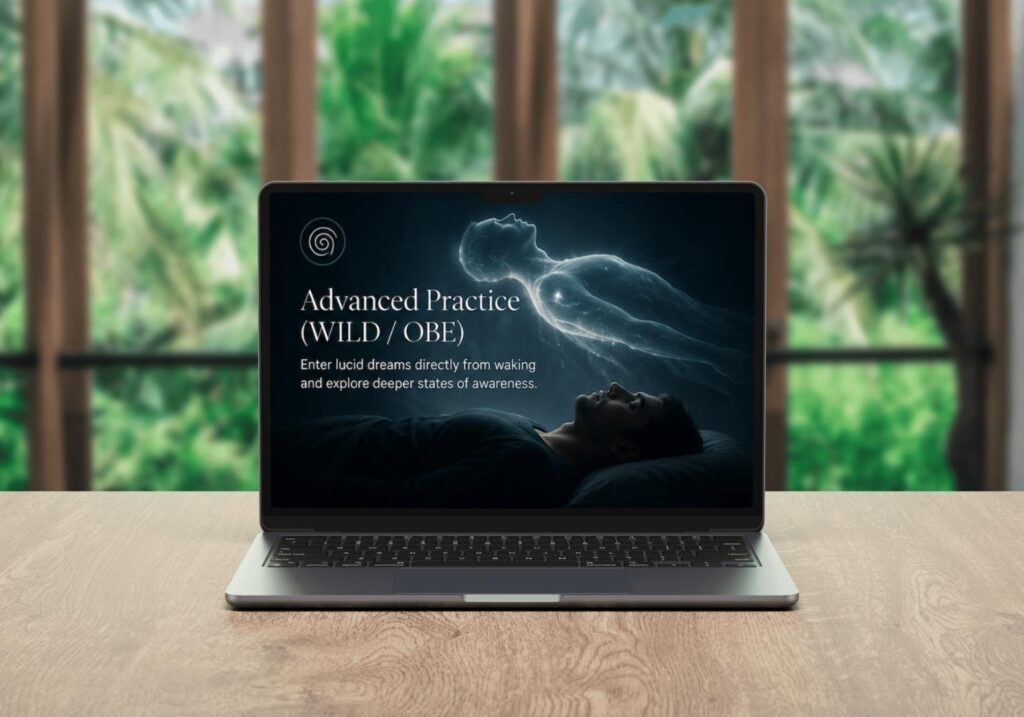
Wake-Initiated Lucid Dreaming (WILD) is the practice of remaining conscious as the body falls asleep.
Instead of becoming lucid after a dream has already begun, you learn to observe the transition itself — remaining aware as perception, sensation, and consciousness gradually shift into the dream state.
For many people, this begins with hypnagogic experiences:
fleeting imagery, sounds, vibrations, dream fragments, or unusual bodily sensations appearing at the edge of sleep.
With practice, these transitional states can become increasingly stable and immersive, allowing awareness to continue directly into lucid dreaming.
This course approaches these experiences through direct observation, practical training, and grounded exploration — without forcing a fixed belief system or interpretation.
What You’ll Learn & Practice
Inside the course, you’ll learn how to consciously enter lucid dreams from waking awareness and navigate altered states with greater clarity, stability, and control.
Topics include:
• Wake-Initiated Lucid Dreaming (WILD) step-by-step
• hypnagogic imagery and conscious sleep transitions
• meditation and nervous system regulation for deeper awareness
• vibrations, dream-body sensations, and exit experiences
• flying, teleportation, movement, and interaction within dream / OBE environments
• manifestation, sensory amplification, and dream control
• understanding how perception and intention function during lucid dreams and OBEs
• stabilizing awareness during intense or unfamiliar experiences
• dream recall, emotional regulation, and overcoming common obstacles
• consciousness exploration, Dream Yoga, and spiritual perspectives
The course also includes:
• 3+ hours of structured video training
• guided meditations and practical exercises
• progressive training structure for long-term development
• lifetime access across all devices
The approach combines practical techniques, meditation-based training, and psychological grounding — helping you build consistent experience rather than relying on luck or random lucid dreams.
- Introduction to Wake Initiated Lucid Dreaming
- First steps into conscious sleep transitions
- My first OBE experience
- Guided meditation instructions
- Understanding altered states & lucid dreaming
- My personal WILD / OBE method
- Hypnagogic imagery & sleep transition
- Meditation and relaxation techniques
- Exit and separation methods
- Returning safely to the body
- Troubleshooting common obstacles
- Vibrational state training
- Conscious dream entry (WILD)
- Stabilizing awareness
- Common mistakes & mindset
- Robert Monroe-inspired methods
- Goal-oriented meditation practices
- Flying and movement techniques
- Teleportation & relocation
- Passing through walls
- Manifestation & astral senses
- Memory access & self-healing
- Understanding sleep paralysis
- Dream herbs & supplements
- Binaural beats & lucid dreaming tools
- Consciousness & metaphysics
- Shamanic dreaming traditions
- Tibetan Dream Yoga
- Further learning & spiritual exploration
The Threshold Between Waking and Dreaming
There is a unique quality to the WILD state.
The body becomes deeply relaxed while awareness remains present and alert. Ordinary sensory perception begins to fade, while dream imagery, sensations, and altered states of consciousness gradually emerge.
People often report experiences such as:
• vibrations or energetic sensations
• floating, movement, or dream-body experiences
• hypnagogic imagery and sound
• altered perception of space, identity, and self
• direct transitions into lucid dreams from waking awareness
Across different traditions, these experiences have been described in different ways:
as lucid dreaming, out-of-body experiences (OBEs), astral projection, subtle-body practice, or meditative states of consciousness.
Much of the information online around these experiences tends to move toward either extreme skepticism or unquestioned belief.
Rather than asking you to adopt a fixed worldview, the emphasis here is placed on direct observation, careful exploration, and developing awareness across changing states of consciousness.
Some people interpret these states psychologically or neurologically. Others approach them spiritually or symbolically. Many move between multiple perspectives over time.
What matters most here is not belief — but learning how to remain conscious, stable, and aware during the experience itself.
Over time, the practice becomes less about chasing extraordinary phenomena and more about deepening your relationship with awareness.
Meditation, Awareness & Dream Yoga
At deeper levels, WILD becomes more than a lucid dreaming technique.
It becomes a form of awareness training.
Meditation helps develop stillness, concentration, emotional regulation, and continuity of awareness — all of which support conscious transitions between waking and dreaming.
This relationship between meditation and lucid dreaming has been explored for centuries within contemplative traditions, including Tibetan Dream Yoga, where awareness is intentionally cultivated across changing states of experience.
For some people, these practices gradually become more than techniques for lucid dreaming.
They become a way of exploring consciousness itself.
Experiences arising during WILD states can sometimes feel profoundly meaningful, emotionally intense, or spiritually significant. People may encounter archetypal imagery, experiences of unity, expanded identity, deep stillness, creativity, or symbolic material emerging from the subconscious mind.
Others experience these states more psychologically — as dream imagery, memory, emotion, and imagination interacting in unusual ways.
This work does not require adopting a specific spiritual belief system.
Instead, the aim is to explore these states openly, carefully, and through experience — while remaining psychologically reflective and grounded.
Not everyone is interested in these deeper dimensions, and they are not necessary in order to successfully practice WILD.
But for some people, these practices gradually become part of a broader exploration of awareness, perception, identity, and consciousness itself.
Who This Course Is For
This course is designed for:
• lucid dreamers wanting to explore conscious state entry
• meditators and consciousness explorers
• people curious about WILD, OBEs, and hypnagogic states
• those seeking a grounded and structured approach to altered states
• experienced practitioners wanting a deeper awareness-based framework
You do not need prior experience with WILD or OBEs.
Even if you’ve struggled with these practices before, the course is designed to help you approach them gradually, safely, and systematically.
Student Experiences
It is one of the best courses in astral projection. As usual, Peter did it in a simple easy understandable and attractive way. I enjoyed each part of it and keep watching it multiple times /...thanks peter for such a wonderful course.
Ossama Hakim
On my first try I almost reached the OBE state, but I think the vibrating phase is already an experience in itself!
M.B.A.
This was my second course after doing The Lucid Dreaming. Very easy to understand and the exercises are not complicated. I liked all the different alternatives to accomplish an OBE. I sincerely recommend this course. You will enjoy it. A++++++!
Hector Manjarrez
After watching Peter’s material, I started remembering my dreams every night and writing them down. I explored many resources on lucid dreaming and astral projection before, but this was the clearest and most useful for me.
Susanna O.
Continue Beyond the Course
Many students begin with structured training and later deepen their practice through Weekly Dream Practice — a live guided group space focused on lucid dreaming, dreamwork, meditation, and ongoing awareness development.
Inside the weekly sessions, you can:
• ask questions and receive guidance
• refine your WILD practice
• troubleshoot obstacles and patterns
• explore dreams and altered states in a grounded setting
• build consistency through ongoing practice
Frequently Asked Questions
For most people, WILD practices are safe when approached gradually, with proper rest, emotional balance, and realistic expectations.
Experiences such as vibrations, sleep paralysis, hypnagogic imagery, or unusual bodily sensations can sometimes feel intense at first, but they are commonly reported transitional states connected to the sleep process.
The course emphasizes grounding, nervous system regulation, emotional stability, and gradual progression rather than forcing experiences.
This varies significantly from person to person.
Some people experience lucid dreams, vibrations, or conscious transitions within days. For others, it may take weeks or longer of consistent practice.
Progress often depends on factors such as sleep quality, stress levels, dream recall, meditation experience, emotional regulation, and consistency of practice.
The aim of the course is not only quick results, but helping you build a stable long-term foundation for conscious dreaming and awareness development.
The practices in this course are designed to work with healthy sleep rather than against it.
Some techniques involve becoming more aware during transitions between waking and sleeping, which can occasionally increase alertness at first while learning.
However, the course also includes relaxation, meditation, and nervous system regulation practices intended to support balance and recovery.
The emphasis is on sustainable practice — not sleep deprivation or extreme methods.
Vibrations are very common during WILD practice and are discussed extensively throughout the course. Despite popular belief, sleep paralysis is not especially common, even among lucid dreamers.
One of the most important parts of training is learning how to remain calm, oriented, and aware during unusual states rather than reacting with panic or excessive excitement.
The course provides practical methods for working with fear, stabilizing awareness, navigating vibrations, and safely returning to waking consciousness whenever needed.
Begin Exploring Conscious Dreaming
Wake-Initiated Lucid Dreaming is not simply about unusual experiences.
It is a practice of awareness — learning to remain conscious as perception, identity, and ordinary waking experience begin to shift.
Join over 35,000 students worldwide and learn to consciously explore the transition between waking and dreaming through grounded, structured practice.